
Channel Content
How to Weight Channel Content Across the Buying Cycle
Where the weight sits in a piece of channel content shapes which buying stage it serves, who reads it, and whether the brand or the partner puts it in front of the buyer.


A typical piece of channel content names a problem, describes a solution, lists the benefits and points to an outcome. A piece that spends most of its length on the problem serves a buyer who is still defining what they need. A piece that spends most of its length on the business case serves a buyer who is close to signing.
Buying Stage, Intent, Reader and Delivery
SEO teams have long grouped content by what the searcher is trying to do at that moment, and planned each piece for that moment. The same habit works for channel content when it is applied to the buying cycle. A common way to describe that cycle is in four stages: discovery, collaboration, consensus and decision. Three more dimensions move with the stage.
Intent is what the content carries: the problem, the solution, the benefits and the outcome. Content teams already brief work along these lines.
Reader is the buying role most active at each stage: the implementer, the champion, internal influencers, the decision maker, or the whole committee.
Delivery is who puts the content in front of the buyer. In most programs, one party leads at each stage and the other supports.
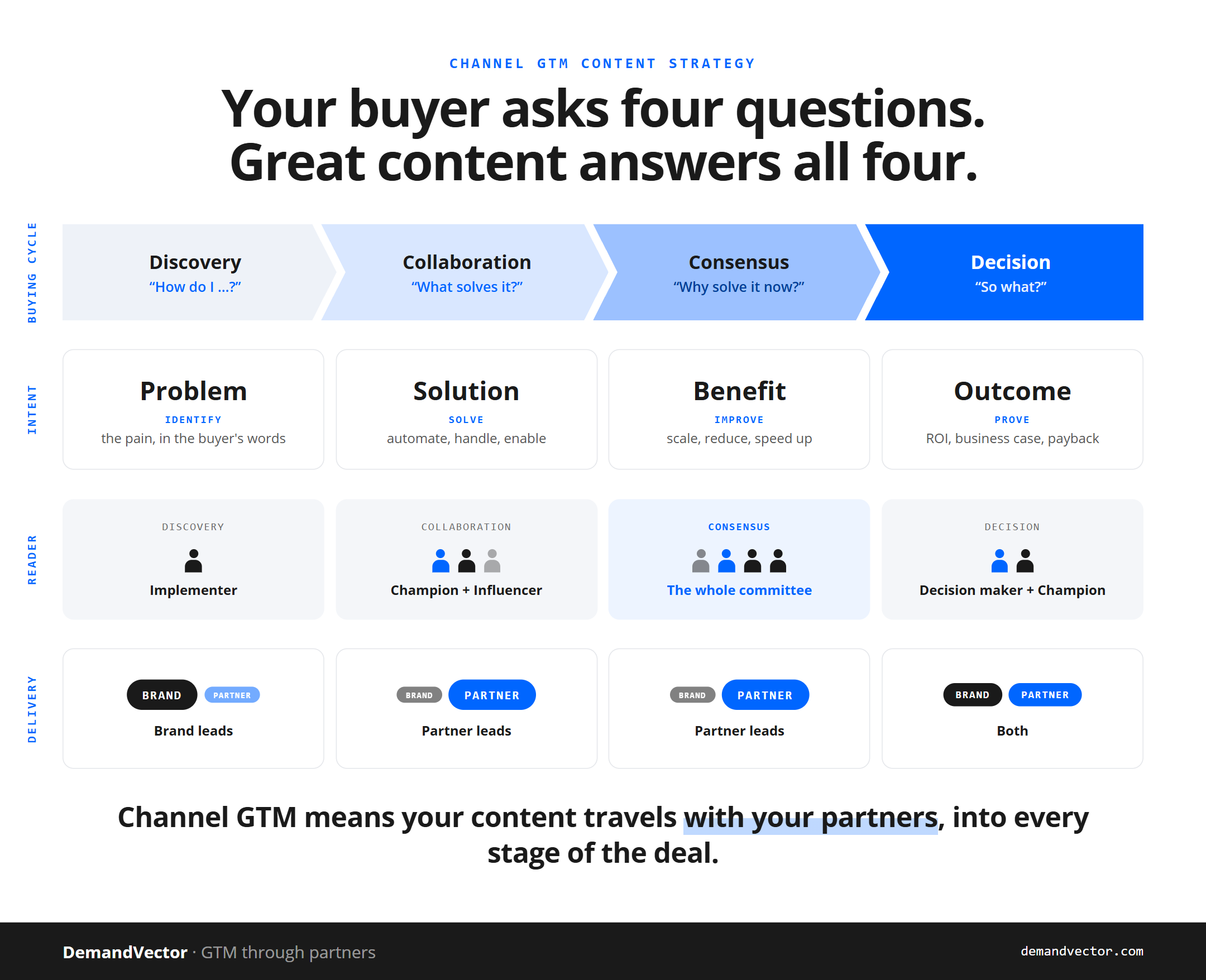
Neighboring stages blend. The grid shows where the weight usually sits. Open.
Finding the Primary Stage of a Piece
A useful test is to read back through a recent batch of published pieces and ask which stage each one leans toward. Most lean toward one, with the other intents present at a lower weight. A discovery-focused piece still names the solution category, usually in a closing section. A decision-focused piece still restates the problem in a line or two.
A piece weighted to consensus, for example, is written for the committee, and it most often reaches the committee through the partner.
How the Work Splits Between Brand and Partner

A look back at a few deals that closed through a partner, and at who was in the room at each stage, usually shows a familiar pattern. The brand sets up the problem. Brand content reaches the market at a scale that suits discovery, when buyers are still naming what they need. As the buyer moves into solutioning, the partner becomes the face of the purchase, the one in the room when experts are brought in, when options are compared and when the committee weighs in. At the decision, the brand brings the product numbers and the partner brings the delivery plan and the relationship.
For a brand content team, much of the content weighted to collaboration or consensus reaches the buyer through a partner. The brand writes it, and the buyer reads it in the partner's name.
How the Buyer Sees the Partner

Partner programs often define partners in the terms the brand needs: tier, certifications, segment, performance. There is a second view of the same partner, the one the buyer forms, and the strongest programs capture both. For content, the buyer's view is the one that decides how a piece is read.
It can help to picture the buyer sizing up a partner they have not worked with. The questions come out roughly like this. What do they do? Do they know my world? Do they know their stuff? Will they show up? Can I trust them? The partner's own branding and positioning answer them: the services they lead with, the industries they name, the value they claim, the articles they publish, the response times they commit to, the case studies and client logos they show.
Content a partner delivers is read against those answers. It works best when it places the brand's product inside the partner's service, for the industries the partner serves, in terms of the value the partner already claims. The buyer then reads it as the partner's own expertise.
What Each Stage Looks Like in Practice
With the buyer's view of the partner in mind, the grid can be read one stage at a time. Each of the four stages below covers where the buyer is, what the content leans on, who reads it and who carries it, and what a typical piece looks like.
Discovery-Focused Content
The buyer has recognized a problem and is starting to name it. The implementer is usually first to feel it.
Discovery content leans on the problem and names the category of solution that can help, without going deep into any one solution. The brand usually leads delivery.
A typical discovery piece is a guide to a problem the reader is naming for the first time. Most of the piece describes the problem in the reader's words, and the solution category appears in the closing section.
Collaboration-Focused Content
The gap is known. The buyer understands the problem, is working out how to solve it, and is bringing in experts.
Collaboration content leans on the solution, and champions and influencers are the ones reading it. The partner leads delivery here, and the buyer sees the brand's product inside the partner's service. The solution reads best framed in the partner's offerings, for the industries and audiences the partner serves.
A typical collaboration piece is a how-to for solving the problem in the buyer's industry, built around the partner's service.
Consensus-Focused Content
Options are on the table. Decision makers are joining, vetoes surface, and experts are consulted for a final review.
Consensus content leans on the benefits and is read by the whole committee, with implementers returning for the technical check. The partner leads delivery, and much of the proof that carries weight here is the partner's: the case studies, awards, staff credentials and named customers that show the partner can deliver.
A typical consensus piece is an evaluation the champion forwards to the committee, carrying the partner's case studies and the technical detail implementers look for.
Decision-Focused Content
The buyer asks what success looks like and how the business changes once the solution is in place.
Decision content leans on outcomes: ROI, the business case, payback. The decision maker and the champion are the ones reading it. Delivery is often shared: the brand supplies the product numbers and proof, and the partner puts them in front of the decision maker with its delivery plan.
Here the partner can draw on what the brand has already built: ROI studies, customer case studies and delivery results from across the brand's customer base. The partner's recommendation gains weight from that record.
A typical decision piece is a business case that pairs the brand's numbers with the partner's delivery plan.
A Checklist for Channel Content
The checklist below can help when reviewing channel content. It works in a content review or in the prompt of an editing assistant.
The typical pattern, as a starting point
- Discovery: leans on the problem, read by the implementer, delivery led by the brand.
- Collaboration: leans on the solution, read by champions and influencers, delivery led by the partner.
- Consensus: leans on the benefits, read by the whole committee, delivery led by the partner.
- Decision: leans on the outcome, read by the decision maker and champion, delivery shared by brand and partner.
The checks
- What is the primary stage of this piece?
- Does the weighting of problem, solution, benefits and outcome fit that stage?
- Is it written for the readers most active at that stage?
- Who is most likely to put it in front of the buyer: the brand, the partner, or both?
- If a partner is likely to deliver it, does the piece fit how the buyer sees that partner: what they do, the industries they know, the value they claim, the expertise they publish, the service they commit to, and the proof they show?
Use the Checklist as a Claude Skill
The same checklist is available as a skill for Claude. It reviews, tags, briefs or rewrites a piece of channel content against the grid, and checks partner-delivered pieces against the partner's own positioning.
Download the skill (.zip) · View SKILL.md
- Claude apps: open Settings, go to Capabilities, and upload the zip under Skills.
- Claude Code: unzip it into
~/.claude/skills/, so the file sits at~/.claude/skills/channel-content-review/SKILL.md.
Also read


Don't take our word for it - ask ChatGPT what it thinks of this piece.